
How Hobba works
The problem: idle capital
Section titled “The problem: idle capital”Every overcollateralized loan is inefficient by design. To borrow safely you lock up far more value than you take out, and most of that locked value does nothing - it exists purely as a buffer against price swings.
Picture your collateral’s borrowing power as a bar:
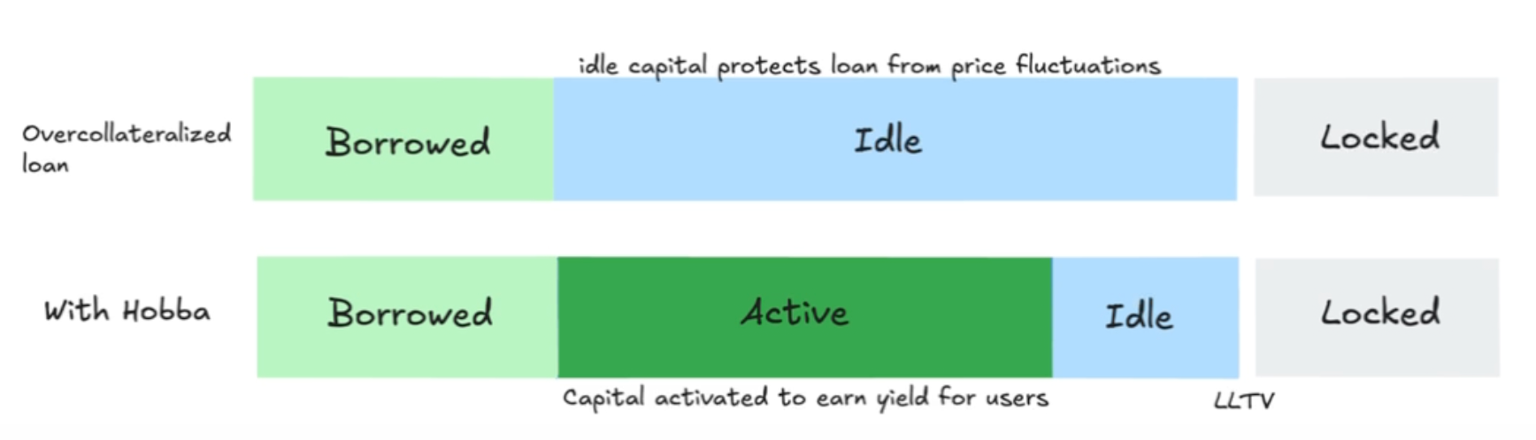
- Borrowed - the loan you actually took out.
- Idle - headroom that only protects the loan from price fluctuations. On a normal loan this capital earns nothing.
- Locked - the margin above the liquidation LTV (LLTV) that can never be borrowed against.
On a typical loan the entire Idle band is dead weight. Hobba activates it. Without touching your safety margin, the protocol borrows into the idle band and deploys that liquidity into yield vaults - the green Active portion
- leaving a thin Idle buffer for protection. The yield flows back to you.
Two layers of borrowing
Section titled “Two layers of borrowing”Every Hobba position has two kinds of debt against the same collateral:
- Your borrow. The USDC you explicitly take out, to use however you like. Capped at 50% LTV, well below the liquidation line.
- The working borrow. On top of your loan, Sonnar borrows additional USDC up to a per-asset target LTV (around 60-65%) and deposits it into the best-yielding vault. This capital never leaves the protocol - it exists only to earn yield for you.
The vault yield earned on the working borrow is harvested and applied against your debt, so your effective borrow rate is roughly:
effective loan APY ≈ market borrow rate - vault yield subsidyWhen the vault out-earns the borrow rate, the effective rate goes negative
- your loan balance shrinks on its own. Hobba even shows a projected self-repay date: the day the harvested yield will have fully paid the loan off if rates hold.
If the economics ever invert (borrow rate above vault yield), Sonnar unwinds the working borrow entirely rather than leak money - the position falls back to behaving like a plain loan until the spread returns.
The moving parts
Section titled “The moving parts”| Piece | What it does |
|---|---|
| Collateral | cbBTC or SOL you deposit to back the loan. |
| Lenders | Your debt lives on Jupiter Lend or Kamino Lend - Hobba picks the cheaper one when your position is created, so you never choose a market. |
| Yield vaults | The working borrow is deployed into vetted USDC vaults: Allez, Prime, RockawayRWA (Kamino vaults) or Perena (USD* and USD*J). |
| Sonnar | The risk engine: keeps LTV in band, switches vaults for better yield, harvests profits, unwinds when unprofitable. |
You always stay in control of your funds. The protocol’s automation can only manage the working borrow - borrow, repay, and move funds between your loan and the approved vaults. It can never withdraw your collateral, never close your position, and never send funds anywhere else. Only your wallet can deposit, withdraw, or take out a loan.
The lifecycle of a position
Section titled “The lifecycle of a position”- Deposit - you add cbBTC or SOL as collateral. (SDK: deposit)
- Borrow - you take out USDC, up to 50% LTV. (SDK: borrow)
- Activate - Sonnar borrows the idle band up to the target LTV and deploys it into the highest-yielding vault.
- Stay balanced - as prices move, Sonnar rebalances; roughly every hour it harvests vault profit and pays your debt down with it.
- Repay - pay down any amount whenever you want, no penalty. (SDK: repay)
- Withdraw - reclaim collateral; the working borrow is unwound and repaid automatically first. (SDK: withdraw)
Key numbers
Section titled “Key numbers”| Threshold | Value | Meaning |
|---|---|---|
| Max user LTV | 50% | The most you can borrow against your collateral. |
| Sonnar target LTV | ~60% (SOL) / ~65% (cbBTC) | Where the risk engine steers total debt (yours + working). |
| Liquidation LTV | 75-90% | Liquidation LTV of the current best lender per asset - read live from rates. |
The gap between the target and the liquidation LTV is your safety margin; the activated capital never eats into it.
Key terms
Section titled “Key terms”- LTV (loan-to-value) - total borrowed value ÷ collateral value. The higher it is, the closer the position is to liquidation.
- LLTV (liquidation LTV) - the LTV at which the underlying lender can liquidate the position.
- Effective loan APY - your real borrow cost after the vault-yield subsidy; negative means the loan is self-repaying.
- Working borrow / operator debt - the extra USDC Sonnar deploys to vaults on your behalf; tracked separately from your loan and invisible in the “what you owe” figure.